Drayton Hall celebrates National Public Gardens Day!

Last weekend, Drayton Hall participated in National Public Garden Day at Magnolia Plantation and Gardens. We were happy to share with the guests some of the activities we do at Drayton Hall that celebrate the joy of the natural world. Read on for a write up of the day from Tara White, Drayton Hall Interpreter.

Children at the Drayton Hall table experiment with pluff mud drawings!

Children at the Drayton Hall table experiment with pluff mud drawings.

Amid the spring blossoms and excited visitors, Drayton Hall’s education programs were on full display at the 2013 National Garden Day Exposition held at Magnolia Plantation and Gardens. We set up a table to exhibit pictures, brochures, and educational activities beginning at 9:00 and lasting until about 2:00. With Drayton Hall’s participation, nearly 200 children created leaf rubbings and pluff mud paintings, two of the activities from our Marsh Madness program. We interacted with students enjoying a school field trip, homeschoolers with their parents, and even tourists that just happened to be visiting Magnolia on Garden Day!

Drayton Hall celebrates National Public Gardens Day!

Drayton Hall celebrates National Public Gardens Day!

Pluff mud finger-painting was by far the favorite activity, giving children a chance to dig their finger into a jar of the local marsh material, designing a painted masterpiece of their own. Many children excitedly told us how much fun it was to play with mud, something that was usually off-limits for them! Nearly all of the teachers and parents we spoke with knew very little about Drayton Hall’s IMG_2444educational programs, and eagerly wanted to learn about our standards-based curriculum. By talking to both the children and adults, the exposition provided Drayton Hall an incredible opportunity for education, outreach, and fun for all who visited Magnolia on National Garden Day!

Author: Tara White

Tara is an educator and interpreter at Drayton Hall where she leads public tours and educational school programs. She holds a bachelor’s degree in history and art from Samford University in Birmingham, Alabama. In addition to educating visitors at Drayton Hall, she is a teaching artist at the Gibbes Museum of Art. 

Local Conservation News!

For the past four years, Drayton Hall has represented the Ashley River Historic District in a regional planning effort administered by the Charleston, Berkeley and Dorchester Council of Governments (COG). The plan would guide our elected officials to the best means of keeping our rural and natural areas protected while fostering intelligent growth in our urban and suburban centers. Planners generated models that were used in rounds of public feedback—culminating in the final draft of “Our Region Our Plan.” The Plan, complete with futuristic visualizations of corridors and growth centers, is being presented to all of the different jurisdictions throughout the lowcountry this April.

This Vision Plan shows a sustainable path for growth over the next 30 years. Click to enlarge.

This Vision Plan shows a sustainable path for growth over the next 30 years.
Click to enlarge.

While Our Region Our Plan is not a mandate, it offers a working guide for decisions about roads and development that will inevitably be made in order to accommodate the estimated 200,000 people moving to the tri-county area by 2040. Towns, cities, and counties now will have a more integrated picture of their role in the quality of life and economic vitality of the entire region. Decisions about roads and developments in Hollywood affect the residents of West Ashley, and decisions made in the downtown corridor affect residents living all around the peninsula.  Most importantly, this Plan prompts the different municipalities and regions to cooperate with each other. A total of five jurisdictions have the power to determine how the land and water around Drayton Hall are managed, so we especially value cross-jurisdictional cooperation when it comes to addressing issues that impact our historic resources.

Drayton Hall Executive Director George McDaniel, (far left), and Director of Preservation and Education Carter Hudgins (third from left) attend a regional planning workshop.

ABOVE:  Drayton Hall Executive Director George McDaniel, (far left), and Director of Preservation and Education Carter Hudgins (third from left) attend a regional planning workshop.

Thankfully, Our Region Our Plan also draws from other successful models in the country to demonstrate that we can keep our rural areas rural while growing dense urban centers. By using forward thinking zoning policies that preserve the characteristics that we all cherish in our rural lowcountry areas, we can preserve our irreplaceable landscapes. Up-and-coming sustainable developments, like nearby East Edisto, exemplify the kind of settlement patterns that will keep our beloved historic district what it is, so future generations can enjoy it.

So what will keep this Plan from just collecting dust on the shelf? The chair of Our Region Our Plan, Councilman Larry Hargett, kept the answer simple. “You and I and our elected leaders will determine this. COG is just here as a reminder.”  The political will of citizens has to be a driving force behind the way that our streets, communities and highways are constructed. We have a powerful voice and we have to use it.  For this reason, Drayton Hall has continued to stay involved in grassroots planning efforts over the years in order to voice support for opportunities to enhance the rural character of the district, such as establishing public parks at Ashley River Road’s northern gateway in Dorchester County.

As is evident in many areas throughout the country, badly planned development destroys the quality of the places where people live, work, and play. The decisions that control this type of growth happen in planning commission and council meetings. We know from this plan that it is possible to preserve our local resources and accommodate for the increases in jobs, housing, and other infrastructure that the area will require.  Our Region Our Plan can now be used by citizens to advise our officials in taking advantage of this varied set of solutions for guiding development and investment.

 Want to help Drayton Hall in our efforts to preserve this beautiful place? Become a Friend of Drayton Hall, or contact our Conservation Coordinator Eugenia Payne at eugenia_payne@draytonhall.org. Your voice matters! 

Birdwatching at Drayton Hall

Recently, Drayton HBob Savage, birding - 3-20-13, croppedall was excited to welcome Bob Savage to the site. Bob is a Long Island native, and a self proclaimed “Bird Nerd.” Bob grew up in Brooklyn, spent his entire adult life on Long Island, and beginning in the mid-80s began to travel regularly to Kiawah, and then later Stono Ferry. He says that his love of birds was sparked by a simple homemade feeder that he put up outside his kitchen window. This one feeder inspired him to add more and more, which led him to buy a pair of binoculars and a bird guide. As they say, the rest is history! Since he discovered his passion for bird watching, he has traveled extensively – to Florida, Arizona, California, and as far away as the United Kingdom and Costa Rica, where he has seen over 800 species of birds.

Owl 1 of 3Bob arrived to start his bird watching at 8:00am, armed with his binoculars and a guide. Although
the weather didn’t cooperate, Bob was pleased to see so many different species of birds in so many different habitats. He explained to us that the beauty of bird watching at Drayton Hall is in the number of different habitats in such a compact space. In the swamp areas he saw yellow warblers, who like the big pines along the border of the swamp. The other habitats, like the lawn area, pond and forest, also yielded other wonderful species. Bob was lucky enough to spot a great horned owl, which he says you usually only see near dawn and dusk. He also told us he has never seen as many Flickers grouped together like he saw during his expedition!  Unfortunately, the wind picked up fairly quickly and the bird activity dropped – luckily, Bob was so pleased with his visit that he’s going to come again later in the spring to try to spot even more species. His advice to would-be birders is simple and straight to the point. If you want to start bird watching, head out to Drayton Hall early in the day — all you need to bring with you are binoculars, a bird guide, and lots of patience!

Drayton Hall is Cleaning House!

Although this post is a few years old, it explains what exactly we do when we close our doors to the public for our annual closed week. Although there might be some pizza parties and ice cream served, it’s not all fun and games- read on the see what we do when you’re not here! 

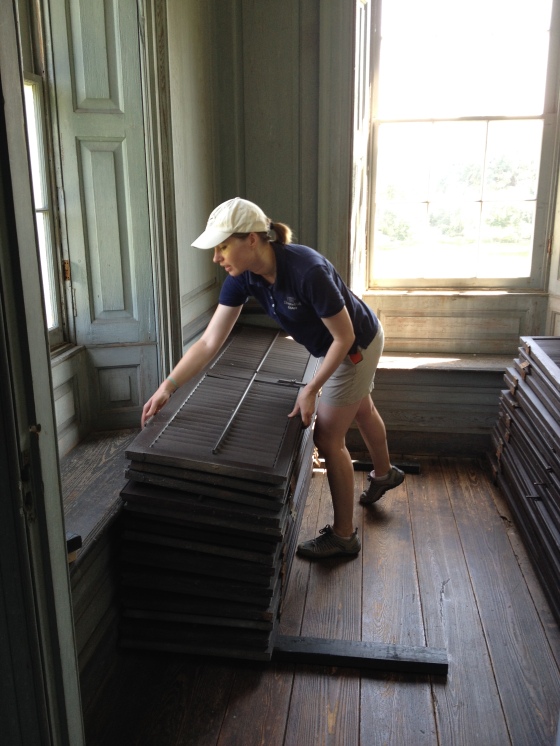
For one week a year, Drayton Hall closes its doors to visitors so that we can complete a top-to-bottom cleaning of the inside of the house, make any large-scale repairs, and take care of other maintenance that is difficult to do when visitors are on the site.  This year, we trimmed up trees along the driveway and throughout the grounds, cleaned windows, walls and floors inside, painted the bathrooms, cleared brush at the African-American cemetery, and made great progress on repairs to the historic mortarwork of the main house.   Take a closer look here.

Visitor Services Manager Kate Ruhf explains more in this video on YouTube.

Matt Webster, Director of Preservation, also describes how the historic mortarwork is repaired in this YouTube video. 

Reflections on our Fall Education Season

Rikki Davenport is our Curator of Education and oversees everything student related (plus a whole lot more) at Drayton Hall. Read on for some thoughts on our most recent season of programs for students at Drayton Hall. 

I love fall at Drayton Hall. The days are sunny, the humidity is gone, and children are everywhere! Our fall education season had 4,450 students, teachers, and chaperones dotting our landscape as they participated in a variety of our education programs. From investigating an 18th century building to colonial cooking and camp life for soldiers, our young historians learned about the role of Drayton Hall in American history and how that history connects to their own lives.

Fourth grade students at the camp life station of The American Revolution program.

Fourth grade students at the camp life station of The American Revolution program.

Nearly 3,000 of our students were fourth graders from Charleston County schools. Each of these fourth grade students participated in pre- and post- program testing to measure their growth in content knowledge in topics such as colonial life and the American Revolution. We are pleased to report a nearly 20% increase in the post-program test scores over the pre-program test scores. We are very proud of our local fourth graders and all of our visiting students who understand the importance of history and serve as wonderful ambassadors for Drayton Hall.

Middle school students investigating an 18th century building.

Middle school students investigating an 18th century building.

Two of our fall season participates had this to say:

“This place is really great! You can learn all about social studies here.” –Jackson, fourth grader from JB Edwards in Mt. Pleasant 

“I was one of the 4th grade teachers who had the privilege of joining our students on this trip (The American Revolution: War Comes to Drayton Hall). Thank you again for an outstanding learning experience outside of the classroom. The kids really enjoyed it. Thanks again for everything and the great comments you made about our kids.”

Laura Ann Shaw, BS Ed.
Fourth Grade Team
Charleston Progressive Academy

A small sample of four Drayton Hall educators represent four Bachelor Degrees, three Master’s Degrees, and fluency is seven languages! From L to R: Phoebe Willis, Betsy McAmis, Eric Snyder, and Leslie Newman.

A small sample of four Drayton Hall educators represent four Bachelor Degrees, three Master’s Degrees, and fluency in seven languages! From L to R: Phoebe Willis, Betsy McAmis, Eric Snyder, and Leslie Newman.

Remembering Samuel Ulin: Witness to the First Emancipation Celebration in South Carolina, 1863 by Toni Carrier

Please welcome our good friend Toni Carrier back to the blog! She was gracious enough to do an interview with us earlier in the year, and we discussed her ongoing research involving Drayton Hall and her amazing work at Lowcountry Africana. (Click here to read the interview.)  Now she’s written a piece for our readers to enjoy about the first Emancipation celebration in South Carolina, which occurred in 1863. Incredibly enough, one of the participants of this joyous celebration was Samuel Ulin, the great-great-grandfather of Rebecca Brown Campbell and Catherine Brown Braxton, descendants of the Bowens-Johnson family formerly enslaved at Drayton Hall.  Rebecca and Catherine are longtime supporters of Drayton Hall, and Catherine was just recently elected to our board. We love how Lowcountry Africana connects us to the past in such a tangible way. Thanks for blogging Toni! 

The morning of January 1, 1863 was greeted with great excitement in the Union military encampment on the Old Fort Plantation of J.J. Smith near Beaufort, South Carolina, for on that day a great celebration was to take place.

Port Royal had been captured on the morning of November 7, 1861. In the days following the capture of Port Royal, some 5,000 African Americans enslaved in South Carolina, Georgia and Florida had escaped from bondage and volunteered to serve in the United States Colored Troops (USCT) to fight for the freedom of those still enslaved [1].

The first full regiment of United States Colored Troops in South Carolina had been mustered in in early November of 1862 as the 1st South Carolina Volunteer Infantry (later designated 33rd United States Colored Troops) [2]. Colonel Thomas Wentworth Higginson, an abolitionist from Massachusetts, had received command of the 1st South Carolina Volunteer Infantry regiment, arriving in Beaufort in late November of 1862. Upon his arrival in camp, he commenced a journal of his experiences, and it is from his journal that we learn of the grand celebration on New Year’s Day of 1863.

Dress Parade of the 1st South Carolina Beaufort LC-USZ62-62492small

Above: Detail from “Dress parade of the 1st South Carolina [U.S.C.V.], Beaufort, S.C.” Library of Congress Digital Print LC-USZ62-62492 No Known Restrictions on Publication.

Higginson had received regimental colors which were to be presented to the new recruits, but the day’s focal point was the reading of the Emancipation Proclamation issued by President Lincoln, which declared all slaves in the Confederate states forever free. For the men who had escaped bondage and lived as free since their muster into the Union army in November 1862, the morning of January 1 brought great joy, for their status would no longer be ambiguous – they would be officially free [3].

And so the day began with anticipation and excitement. Expecting a gathering of some 5,000 celebrants, Higginson had ordered ten cattle to be roasted. About 10:00 a.m. guests began arriving and soon every approach to the Smith plantation was thronged. The ceremony proceeded as planned, with the presentation of the regimental colors and reading of the Emancipation Proclamation. Then, as Higginson described, “followed an incident so simple, so touching, so utterly unexpected and startling, that I can scarcely believe it on recalling, though it gave a key-note to the whole day.”

EMANCI~1

“Emancipation Day in South Carolina” – the Color-Sergeant of the 1st South Carolina (Colored) addressing the regiment, after having been presented with the Stars and Stripes, at Smith’s plantation, Port Royal, January 1
Source: Library of Congress Digital Photo ID LC-USZ62-88808. No Known Restrictions on Publication.

The moment the speaker ceased and as Higginson took and waved the flag, from out of the assembled crowd came a lone male voice in song: “My Country ‘t is of Thee, Sweet Land of Liberty, of Thee I Sing.” This spontaneous celebration was soon joined in by others in the crowd. Higginson described the moment:

I never saw anything so electric. It made all other words cheap. It seemed the choked voice of a race at last unloosed. Nothing could be more wonderfully unconscious; art could not have dreamed of a tribute to the day of jubilee that should be so affecting; history will not believe it and when I came to speak of it after it was ended tears were everywhere.

One of the celebrants who witnessed this event was Samuel Ulin, the great-great-grandfather of Rebecca Brown Campbell and Catherine Brown Braxton, descendants of the Bowens-Johnson family formerly enslaved at Drayton Hall.

CatherineBraxtonRebeccaCampbell

Above: Catherine Brown Braxton and Rebecca Campbell, Descendants of Drayton Hall and Great-Great Granddaughters of Samuel Ulin. Photo Courtesy of Jay Millard

Samuel Ulin had escaped bondage in Florida and made his way to Port Royal, where he enlisted in the United States Colored Troops (USCT) on November 11, 1862. Born in Duval County, Florida, Samuel was 39 when he enlisted in the USCT for a term of three years. Ulin was present at the grand celebration of January 1, 1863 and was one of the Union soldiers of African descent officially freed on that day [4]. Samuel Ulin fought and was wounded in battle on July 9, 1863, when United States Colored Troops in three Union gunships engaged Confederate forces at Willtown Bluff. Samuel was one of 250 troops in the 1st SC Volunteer Infantry who departed Port Royal in three Union gunships – the John Adams, an armed ferry boat steamer, the Enoch Dean, an armed transport and the Governor Milton, an armed tug, on an excursion up the Edisto River on the afternoon of 9 Jul 1863. Their mission was to burn a railroad bridge some 30 miles up the river.

UlinSamuelUSCivilWarPensionIndexGeneralIndextoPensionFilessmall 300

Above: Civil War Pension Index for Samuel Ulin, 33rd United States Colored Troops. Source: Civil War and Later Pension Files, Department of Veterans Affairs, Record Group 15, National Archives, Washington, D.C. Widow’s Pension Application No. 5833301, Nancy Ulin; Service of Samuel Ulin (Pvt., Co. G, 33rd United States Colored Troops, Civil War). Previous Invalid Pension No. 674522; Original Invalid Pension No. 652845

After a difficult journey in heavy fog, they anchored about 4 a.m. near the Morris Plantation. The bridge was defended by a small force of Confederate troops who were forced to retreat, but in the battle Samuel Ulin was shot through the right hand and in the left side of his chest. He was admitted to the Beaufort field hospital where he remained for two months. He was never quite well again, and his disability ultimately resulted in paralysis and his death August 19, 1893. His wife Nora Singleton, Rebecca Campbell and Catherine Braxton’s great-great grandmother, predeceased him in August of 1891 [5].

We do not yet know whether Samuel Ulin married Catherine and Rebecca’s great-great grandmother Nora Singleton before or after his service in the Union army, but because he was among the first soldiers to enlist in the United States Colored Troops in South Carolina, a rich narrative of the events he witnessed survives in two books, now digitized and available on the Internet. The first is Thomas Wentworth Higginson’s diary Army Life In a Black Regiment, which chronicles his experiences while commanding the regiment Samuel Ulin served in (the 1st South Carolina Volunteer Infantry, later designated 33rd United States Colored Troops). The second is Reminiscences of My Life in Camp with the 33d United States Colored Troops Late 1st S.C. Volunteers by Susie King Taylor, an army nurse whose husband was a soldier in the 33rd USCT. You can read the full text of each of these books in the South Carolina Full Text Reading Room on the Lowcountry Africana website.

UlinSamuelCompiledBirthPlaceOccupationPage 23 with border

Left:  Detail from Compiled Service Record of Samuel Ulin. Source: Compiled Military Service Records of Volunteer Union Soldiers Who Served with the United States Colored Troops: Infantry Organizations, 31st through 35th. Database Online at Fold3.com, http://www.fold3.com/title_692/31st35th_infantry/, accessed 13 Dec 2012. Original Data from NARA M1992. Compiled Military Service Records of Volunteer Union Soldiers Belonging to the 31st through 35th Infantry Units, Organized for Service With the United States Colored Troops (USCT).

FURTHER READING:

For more information on the history of the 33rd United States Colored Troops, please see Who Lived This History? The 33rd United States Colored Troops (USCT) on the Lowcountry Africana website.

For Thomas Wentworth Higginson and Susie King Taylor’s accounts of camp life among the 33rd USCT, please visit the South Carolina Full Text Reading Room on the Lowcountry Africana website.

REFERENCES CITED:

[1] Rose, Willie Lee. 1964 Rehearsal for Reconstruction: The Port Royal Experiment. Athens: University of Georgia Press, pp. 194-196.

[2] Rose 1964, pp. 194-196.

[3] Higginson, Thomas Wentworth. 1870 Army Life In a Black Regiment. Boston: Fields, Osgood and Company. Original from Oxford University, Digitized by Google Books 22 May 2007.

[4] Compiled Military Service Records of Volunteer Union Soldiers Who Served with the United States Colored Troops: Infantry Organizations, 31st through 35th. Database Online at Fold3.com, http://www.fold3.com/title_692/31st35th_infantry/, accessed 13 Dec 2012. Original Data from NARA M1992. Compiled Military Service Records of Volunteer Union Soldiers Belonging to the 31st through 35th Infantry Units, Organized for Service With the United States Colored Troops (USCT).

[5] Jones, Keith J. 2011 The Boys of Diamond Hill: The Lives and Civil War Letters of the Boyd Family of Abbeville, South Carolina. McFarland Publishers; Civil War and Later Pension Files, Department of Veterans Affairs, Record Group 15, National Archives, Washington, D.C. Widow’s Pension Application No. 5833301, Nancy Ulin; Service of Samuel Ulin (Pvt., Co. G, 33rd United States Colored Troops, Civil War). Previous Invalid Pension No. 674522; Original Invalid Pension No. 652845.

Christmas in Charleston…A Holiday To-Do List!

Mouth Blown Ornament of Drayton HallEvery year, this week at Drayton Hall proves to be especially exciting. This weekend, for the 29th year in a row, we’ll gather in the raised English basement to enjoy a concert of African-American Spiritual music with three concerts by Ann Caldwell and the Magnolia Singers. Tradition and history is obviously important to all of us here at Drayton Hall. Seeing the same Friends come year after year to enjoy this special holiday tradition always gets us in the spirit of the holidays. If you’ve never been, you’re in for a treat. Click here to be redirected to our page and to buy tickets.

Our friends over at Charming Inns of Charleston compiled this wonderful holiday to-do list, and were kind enough to include the Spirituals Concerts in it. Click here to be directed to their page so you can check off some of the fabulous holiday events they’ve compiled.